
Education System: Unlearning Miseducation To Reclaim Truth
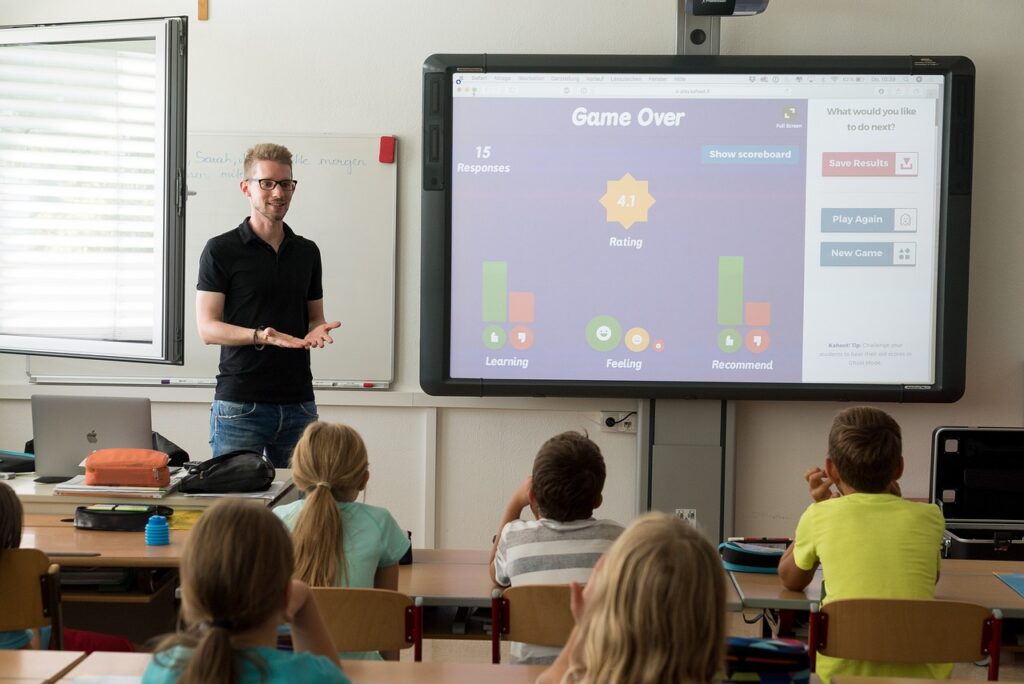
Table of Contents
What Is Education? A Definition Beyond the Textbook
Education is often described as the foundation of societal progress—and rightly so. But true education is more than the delivery of facts; it’s the cultivation of curiosity, awareness, and the ability to think critically. It should teach us how to learn, not just what to know.¹
Yet somewhere along the way, that purpose was distorted. In many education systems today, education has been replaced with miseducation—a model built more on obedience than insight, more on memorization than meaning.² Beneath layers of rigid standards and standardized testing, the deeper purpose of learning is obscured.
To move forward, we must first recognize how miseducation has shaped our understanding—and then begin the process of unlearning it.
Unlearning is all about subtraction.
It’s much more than replacing old information with new. Unlearning is about reframing, letting go, and making room for new ideas. It involves questioning and challenging existing assumptions, biases, or attitudes and being open to new perspectives and experiences.³
Footnotes
¹ Freire, Paulo. Pedagogy of the Oppressed. Translated by Myra Bergman Ramos, Bloomsbury Publishing, 2000.
² Nussbaum, Martha C. Not for Profit: Why Democracy Needs the Humanities. Princeton University Press, 2010.
³ “The Power of Unlearning: How to Let Go of Beliefs to Embrace Success.” Fearless Culture. https://www.fearlessculture.design/blog-posts/the-power-of-unlearning-how-to-let-go-of-beliefs-to-embrace-success
A Historical Perspective: The Evolution of Education
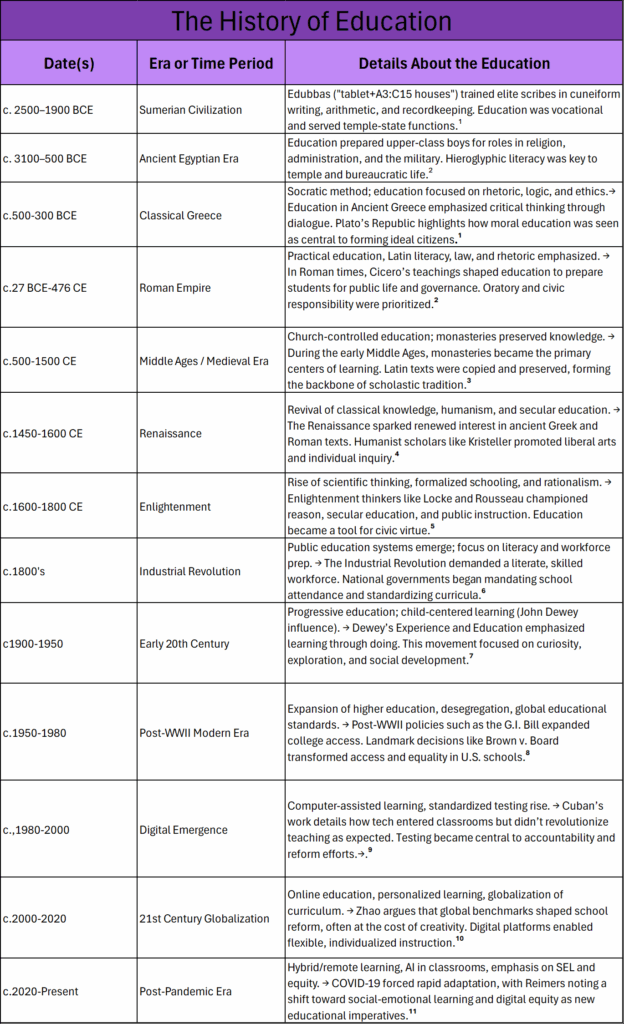
To understand how we’ve arrived at the current state of miseducation, we must first explore where education began—and how it has evolved. From the oral traditions of prehistoric tribes to the algorithm-driven classrooms of the 21st century, education has always reflected the values, needs, and power structures of the societies that shaped it.
Across time, learning has taken many forms: sacred rituals, elite instruction, rote memorization, philosophical debate, and hands-on exploration. But with each era came shifts not only in how we learn, but in why we learn—and for whom the education system was designed.
Here’s a look at the progression of institutional education from ancient times to the development of the modern education system:
By examining the educational models of institutions—Boston Latin School (1635) of Massachusetts Bay Province being a notable example—education quickly became a priority to the Puritans, largely due to their deep involvement in the Protestant Reformation. The ability to read the Bible was a major contributor to this movement.
Led by schoolmaster Philemon Pormont, Boston Latin School was an all-boys school that was strictly for college preparation. The English school taught Latin and Greek and focused heavily on humanities.⁴
Footnotes
⁴ National Geographic Education Staff. “The First Public School in America.” National Geographic Education, 14 Oct. 2022, Link.
⁵ Kramer, Samuel Noah. History Begins at Sumer. University of Pennsylvania Press, 1981.
⁶ Brewer, Douglas J., and Emily Teeter. Egypt and the Egyptians. Cambridge University Press, 2007.
⁷ Plato. The Republic, Book VII.
⁸ Cicero. De Oratore, translated by E.W. Sutton.
⁹ Le Goff, Jacques. The Medieval Imagination. University of Chicago Press, 1988.
¹⁰ Kristeller, Paul Oskar. Renaissance Thought and Its Sources. Columbia University Press, 1979.
¹¹ Outram, Dorinda. The Enlightenment. Cambridge University Press, 2013.
¹² Bowen, James. A History of Western Education, Vol. III. Routledge, 2003.
¹³ Dewey, John. Experience and Education. Macmillan, 1938.
¹⁴ Labaree, David F. Someone Has to Fail: The Zero-Sum Game of Public Schooling. Harvard University Press, 2010.
The Modern Education System: Strengths and Structural Failures

Education plays a crucial role in shaping individuals and societies. Over the years, education systems worldwide have evolved significantly, adapting to technological advancements, changing societal needs, and new teaching methodologies.
While there are many strengths in modern education, several challenges persist. Understanding these strengths and weaknesses is vital for improving education and ensuring it meets the needs of future generations.
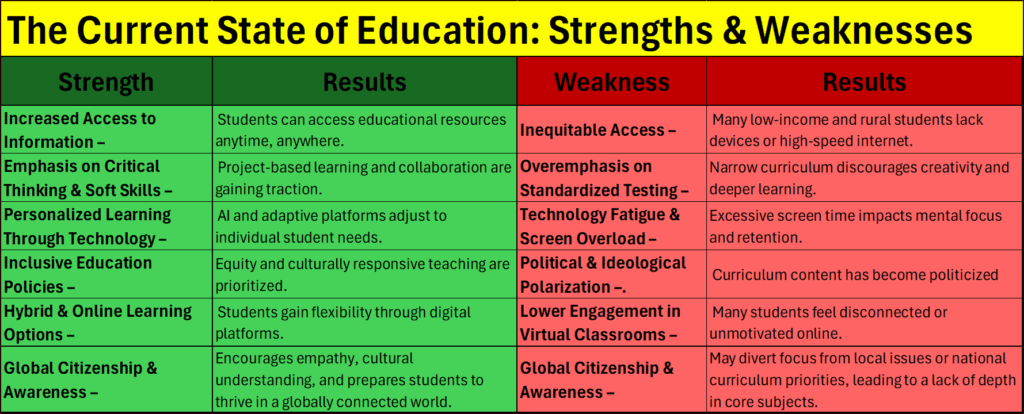
While the chart above provides insight into curriculum-related strengths and weaknesses, several critical issues impacting student well-being and learning outcomes fall outside the scope of curriculum evaluation. These include:
- Lack of Nutrition in School Lunches
- Many public schools offer meals that fall short of nutritional standards, contributing to childhood obesity and poor academic performance.
- ▶️ Solution in Practice: Programs like the USDA’s Farm to School initiative promote healthier, locally sourced meals. Additionally, schools can collaborate with local nonprofits to host food literacy workshops that educate students on nutrition and healthy eating habits.
- Inadequate Funding for Special Needs and Foster Care Students
- Public schools often struggle to provide adequate resources and support for students with special needs, including those in the foster care system.
- In the U.S., approximately 400,000 children are in foster care at any given time. About 20,000 of these youth age out of the system each year, often facing significant educational and emotional challenges.
- A supportive PK–12 education system can serve as a stabilizing force and provide essential life skills and academic support for these vulnerable populations.
- Underqualified Educators
- Many schools, particularly in underserved areas, face persistent challenges in recruiting and retaining qualified teachers.
- This issue affects instructional quality and student outcomes, especially in subjects like math, science, and special education.
- Lack of Physical Education and Recreational Activities
- Budget constraints and academic pressure have led many schools to reduce physical education (PE) programs.
- The decline in physical activity contributes to rising rates of childhood obesity and affects students’ mental health and academic focus.
The Culture of Low Expectations
In a society that celebrates fame over wisdom, convenience over discipline, and entertainment over inquiry, education is seen as a chore, not a calling—by students, parents, and institutions alike.
Students absorb more than just the curriculum—they absorb the values behind it:
- Celebrity culture teaches that influence outweighs expertise.
- Consumer culture tells students that instant results are better than long-term effort.
- Anti-intellectualism, where critical thinking is dismissed as elitism—or results in being called a nerd—undermines the pursuit of knowledge itself.
These values don’t just influence what students learn; they affect how they value learning in the first place.
In such an environment, even the best-funded schools struggle to inspire curiosity, reflection, and depth.
➡️ This culture of low expectations doesn’t end in high school—it echoes into higher education, where students often pursue degrees out of obligation rather than passion.
The Higher Education Illusion: Does College Equal Intelligence?
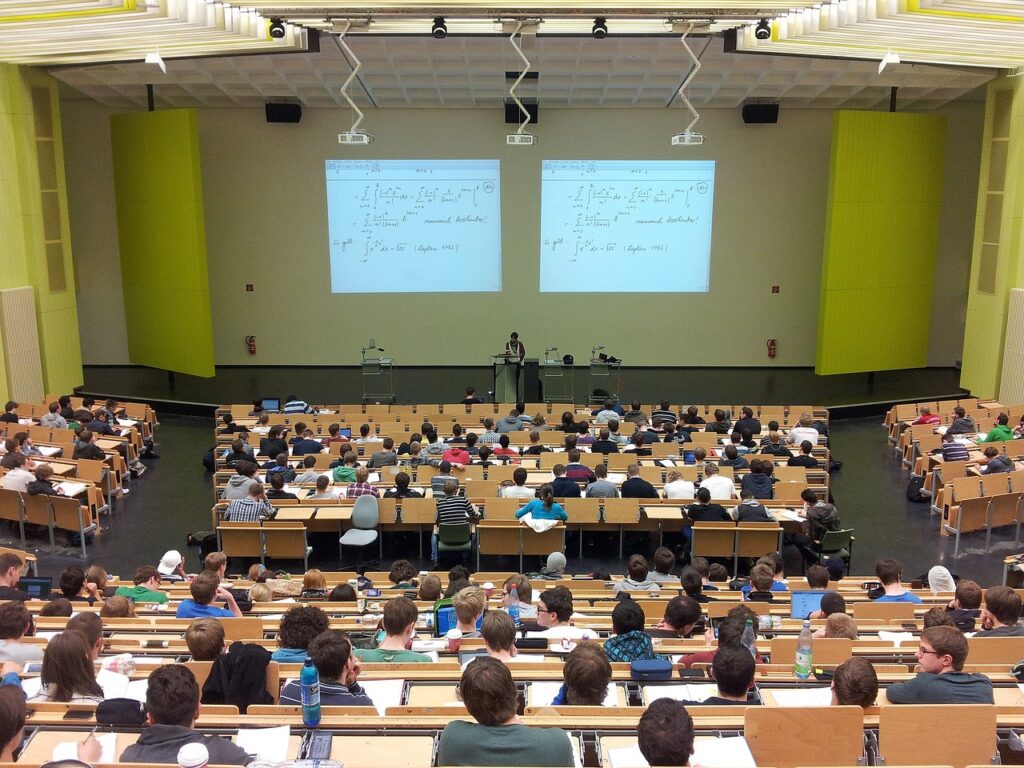
The modern education system isn’t just miseducating students — it’s reflecting a society that has lost touch with the meaning of true education.
Many students today enter college not out of intellectual curiosity or a desire to grow, but because it’s what they’re “supposed” to do. College has become less about developing wisdom and more about signaling compliance, credentials, and status. In this context, degrees are often mistaken for intelligence, and standardized paths are mistaken for success.
Far from being centers of open inquiry, many institutions now resemble bureaucratic machines—geared more toward maintaining enrollment and meeting funding metrics than nurturing the human spirit. Students become disillusioned, seeing higher education not as empowering, but as authoritative and detached from real-world relevance. Those unfamiliar with transformative learning experiences are left navigating a maze of debt, identity crises, and unclear direction.
While culture plays a strong role in shaping how education is perceived—often glamorizing fame over scholarship—there is another powerful force in the mix: government policy. Elected officials and their appointees shape the architecture of education through legislation, funding requirements, and incentive programs. While many of these leaders may have good intentions, their well-meaning initiatives often fall short because they lack direct input from those most affected: students, parents, and teachers.
Too often, policies are passed behind closed doors, based on political agendas or data-driven assumptions that ignore the lived experiences of the people they impact. The result is an education system designed from the top down—detached from grassroots realities and disconnected from the true needs of learners.¹⁶
Footnotes
¹⁵ Legal Center for Foster Care & Education. “Fostering Success in Education: National Factsheet on the Educational Outcomes of Children in Foster Care.” American Bar Association Center on Children and the Law, 2018. https://fostercareandeducation.org/
¹⁶ Carey, Kevin. “The Fundamental Way That Universities Are an Illusion.” The Chronicle of Higher Education, 2023. https://www.chronicle.com/article/the-fundamental-way-that-universities-are-an-illusion
¹⁷ McClay, Wilfred M. “The Crisis in American Higher Education.” National Affairs, no. 51, Fall 2022. https://www.nationalaffairs.com/publications/detail/the-crisis-in-american-higher-education
¹⁸ Vedder, Richard. Restoring the Promise: Higher Education in America. Independent Institute, 2019.
Government Influence on the Education System
The Department of Education was first established in 1867 to gather data and assist in creating effective school systems. However, fears of federal overreach quickly led to its demotion and renaming as the Office of Education just one year later.¹⁹ Fast forward to today, the Department has reclaimed its original name but maintains a relatively limited role, since education is still considered primarily a state and local responsibility.
In fact, during the 2012–2013 school year, the federal government contributed just 8% of the estimated $1.15 trillion spent nationally on education across all levels.²⁰ Most power still lies with states, communities, and private institutions, which control curricula, school standards, and graduation requirements.
Elected Officials: The Quiet Architects of Education
While national debates dominate headlines, local officials quietly shape the educational experience of millions. State legislators, school board members, county commissioners, and city council members hold extraordinary sway over everything from curriculum and funding to infrastructure and safety. Yet voter turnout for school board elections often hovers around just 5–10%, as their names are buried at the bottom of ballots.²¹
Local Officials and Their Roles:
- State Legislators pass education laws and approve school funding formulas.
- Mayors coordinate city resources and oversee local initiatives.
- County Commissioners fund support services like school mental health.
- City Council Members influence zoning, safety, and school development.
- School Board Members adopt curriculum, approve textbooks, and set calendars.
Appointed Officials: Implementation and Oversight
Behind these elected leaders are appointed professionals tasked with enforcing policies and running day-to-day operations. They include:
- State Superintendents who oversee standards, funding, and testing.
- State Boards of Education who set graduation requirements and academic standards.
- Local Superintendents who manage district-wide implementation.
- Principals who carry out leadership within individual schools.
- Policy Advisors and SEA Staff who draft laws and monitor compliance.
- Education Task Forces that analyze reforms and recommend policy shifts.
Foundations in the U.S. Constitution
Although the U.S. Constitution does not mention education explicitly, its structure shapes how power is distributed. The 10th Amendment reserves authority over education to the states, while the 14th Amendment’s Equal Protection Clause ensures that state-led education must still comply with civil rights protections.²²
This principle was tested and affirmed in Brown v. Board of Education (1954), when the Supreme Court ruled that racially segregated schools violated the Constitution.²³
These constitutional and legislative frameworks determine who sets curriculum standards, how funding is distributed, and what rights students have in the public school system.
Footnotes
¹⁹ U.S. Department of Education. “A Brief History of the U.S. Department of Education.” ed.gov, https://www2.ed.gov/about/overview/focus/what.html.
²⁰ National Center for Education Statistics. “Revenues and Expenditures for Public Elementary and Secondary Education: FY 13.” NCES, May 2015. https://nces.ed.gov/pubs2015/2015301.pdf.
²¹ Education Week Research Center. “Voter Turnout in School Board Elections.” EdWeek, 2016. https://www.edweek.org/leadership/voter-turnout-in-school-board-elections.
²² U.S. Constitution. Amendment X and XIV. National Archives. https://www.archives.gov/founding-docs
²³ “Brown v. Board of Education.” Oyez, https://www.oyez.org/cases/1940-1955/347us483
Indoctrination vs. Learning: Are We Teaching or Programming?
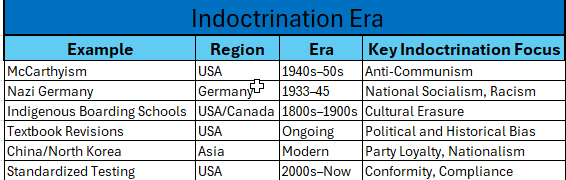
At its core, education is meant to equip students with the tools to think independently. Indoctrination, by contrast, discourages critical engagement and rewards passive acceptance. As defined by WhiteHouse.gov, indoctrination can create “an environment that operates as an echo chamber, in which students are forced to accept these ideologies without question or critical examination.”²⁴
By contrast, learning thrives on lived experience, trial and error, and personal reflection. In true education, questions are as valuable as answers. Indoctrination, however, often replaces inquiry with ideology—offering students a predetermined worldview without encouraging dissent.
Facilitators or Enforcers? The Role of Teachers in Shaping Thought
Many teachers enter the profession with the intent to foster discussion and encourage exploration. But under today’s systems of standardized testing, scripted curriculum, and top-down policy mandates, teachers are often treated less like facilitators of learning and more like compliance officers.²⁵
Whether under pressure from school boards, mayors, state legislatures, or district superintendents, teachers are increasingly constrained by regulations and assessment goals that leave little room for open-ended discussion or creative exploration.
How Standardized Testing Discourages Independent Thought
Standardized tests were originally intended to track student performance and measure learning outcomes. While this purpose still holds value, the execution has become problematic.
Tests are often disconnected from day-to-day classroom teaching. Instead of reinforcing concepts taught through genuine engagement, teachers may feel forced to “teach to the test” using rehearsal strategies that prioritize memorization over comprehension.²⁶
Worse still, high-stakes testing environments tend to marginalize students who learn differently and demoralize teachers who wish to explore deeper themes or encourage creativity.
Is Indoctrination Happening in Schools?
Examples of indoctrination in modern education might include:
- Omitting historical nuance, such as the complexities of slavery, colonialism, or resistance movements.
- Restricting debate on controversial topics like gender, climate change, or political ideologies.
- Promoting one-sided narratives about current events without exposing students to competing perspectives.
- Labeling disagreement as “misinformation” rather than exploring the reasoning behind different views.
These practices risk turning classrooms into echo chambers rather than training grounds for independent thinkers.
Footnotes
²⁴ “Executive Order on Combating Race and Sex Stereotyping.” The White House, 22 Sept. 2020, https://trumpwhitehouse.archives.gov/presidential-actions/executive-order-combating-race-sex-stereotyping/.
²⁵ Kamenetz, Anya. “What the ‘Standardized Testing’ Debate Is Really About.” NPR, 16 Mar. 2021, https://www.npr.org/2021/03/16/976151970/what-the-standardized-testing-debate-is-really-about.
²⁶ Ravitch, Diane. The Death and Life of the Great American School System. Basic Books, 2010.
The Hidden Curriculum: What Schools Don’t Teach
While schools claim to prepare students for the “real world,” a deeper look reveals a glaring omission of the very skills most essential for thriving in adult life. Beneath the official curriculum lies what scholars call the “hidden curriculum”—an invisible system of values, priorities, and behaviors that shapes students without ever being written in a textbook.
This hidden curriculum doesn’t just teach how to obey rules or follow schedules; it also communicates what society values—and what it doesn’t. What’s left out of formal education is often just as telling as what’s included.
Expose the System by Asking What It Avoids
If education is truly meant to empower, then why do so many students graduate without learning how to manage a budget, navigate mental health, question authority, or understand their legal rights?
This isn’t just an oversight—it’s a systemic failure that produces dependency instead of independence. While algebra and grammar are emphasized, many students leave school unable to apply for a loan, critically evaluate media, or prepare a healthy meal.
These gaps affect everyone, but their consequences fall hardest on marginalized communities, who often lack access to these tools outside of school. The system claims to be neutral—but neutrality in the face of inequity only reinforces the status quo.²⁷
Examples of the Hidden Curriculum’s Gaps
Here are just a few neglected subjects and what students miss out on when they aren’t taught:
- Financial Literacy
Without instruction on interest rates, budgeting, or credit, many students fall into debt traps early in life.²⁸ - Civic and Legal Rights
Few young people are taught how local government works or how to advocate for their rights, leaving them disengaged and easily misled.
▶️ **Solution in Practice**: The Center for Civic Education offers free resources and lesson plans on topics like constitutional rights, the justice system, and community activism for middle and high school levels.
- Mental and Emotional Health
Basic tools for coping with anxiety, trauma, or peer pressure are rarely addressed, despite rising youth mental health crises. - Nutrition and Physical Literacy
While sugary school lunches are normalized, most students receive little education on healthy eating or how food affects mental and physical well-being.²⁹ - Media Literacy and Critical Thinking
In an age of misinformation, students are often ill-equipped to assess the credibility of online content or challenge manipulative messaging. - Entrepreneurship and Self-Reliance
Students are trained to be job seekers, not job creators—reinforcing a cycle of economic dependence.
**”The hidden curriculum refers to the tacit teaching of norms, values, and dispositions—often those that maintain existing power structures.”**²⁷
These aren’t just academic failures—they’re structural choices. The education system doesn’t simply forget to teach these things. It avoids them, because teaching them would empower students to question, resist, and reimagine the very systems that marginalize them.
Footnotes
²⁷ Margolis, Eric. The Hidden Curriculum in Higher Education. Routledge, 2001.
²⁸ Lusardi, Annamaria. “The State of U.S. Financial Capability: The 2022 National Financial Capability Study.” FINRA Investor Education Foundation, 2023, https://www.finrafoundation.org/financial-capability.
²⁹ Centers for Disease Control and Prevention (CDC). “Childhood Nutrition Facts.” CDC, 2023, https://www.cdc.gov/healthyschools/nutrition/facts.htm.
Rewriting Reality: How the Education System Shapes Historical Truth and Language Control
Let’s get real—history is rarely neutral. It’s written by victors, sanitized by institutions, and weaponized by those in power to control how we see the world, ourselves, and each other.
In the modern education system, control over history and language isn’t just about curriculum—it’s about power: who holds it, who loses it, and how it shapes public consciousness. From textbooks to classroom discourse, the education system often reflects the interests of dominant groups, deciding which voices are amplified and which are erased. The National Education Association acknowledges that “curriculum choices reflect cultural values and political priorities.”³⁵
Historical events like colonization, civil rights movements, and indigenous resistance are frequently sanitized or selectively told. Inconvenient truths—such as the presence of Black slave owners, white abolitionists who died for the cause, the fact that only a small percentage of Southerners actually owned slaves, and that Black Americans fought on both sides of the Civil War—are often omitted in favor of simplified, polarized narratives. The Zinn Education Project provides open-access resources to challenge these omissions and restore complexity to the historical record.³⁶
However, while supporters applaud efforts like the Zinn Project for centering marginalized voices, critics argue that these initiatives may replace one ideological bias with another.³⁷ Some suggest this shift introduces new dogmas rather than promoting balanced inquiry. Mary Grabar, author of Debunking Howard Zinn, contends that Zinn’s framework promotes a Marxist interpretation of U.S. history—portraying America predominantly as an oppressor while overlooking competing ideologies and complexity.³⁸
Similarly, education scholars such as Sandra Stotsky caution that some modern curricular reforms, though well-intentioned, risk discouraging intellectual growth by prioritizing activism over analytical thinking.³⁹ A report from the Thomas B. Fordham Institute warns that when history is taught as a series of moral certainties, students lose the ability to engage critically with the past—ultimately weakening civic reasoning.⁴⁰
We’ve already seen how the education system has been used to distort history and control language—but that was just the warm-up. The real battle is here: the future of learning is being redesigned in real time, and most people don’t even realize it. Big tech, AI, and policy architects are already rewriting the rules—deciding not only what gets taught, but how minds are shaped from the moment a child picks up a screen. If we don’t take ownership of where education is headed, we’ll find ourselves once again on the receiving end of a system built to control—not to enlighten.
Footnotes
³⁵ National Education Association. “Curriculum and Instruction.” NEA.org.
³⁶ Zinn Education Project. “About.” https://www.zinnedproject.org/about/
³⁷ Hanson, Victor Davis. The Dying Citizen: How Progressive Elites, Tribalism, and Globalization Are Destroying the Idea of America. Basic Books, 2021.
³⁸ Grabar, Mary. Debunking Howard Zinn: Exposing the Fake History That Turned a Generation against America. Regnery History, 2019.
³⁹ Stotsky, Sandra. “History Curriculum: A Missed Opportunity for Intellectual Growth.” Pioneer Institute, 2013. https://pioneerinstitute.org/academic-standards/study-finds-history-standards-fail-to-teach-critical-thinking/
⁴⁰ Pondiscio, Robert. “The End of History Class.” Thomas B. Fordham Institute, 5 Apr. 2021. https://fordhaminstitute.org/national/commentary/end-history-class
⁴¹ U.S. Department of Education. “Mission and Functions.” ed.gov, https://www.ed.gov.
⁴² Singer, Natasha. “Pearson’s Influence on Education.” New York Times, 13 Oct. 2015, https://www.nytimes.com.
⁴³ Ravitch, Diane. The Death and Life of the Great American School System. Basic Books, 2010.
⁴⁴ Heritage Foundation. “Parental Rights and Education Reform.” heritage.org, https://www.heritage.org.
⁴⁵ Guttmacher Institute. “State Policy Trends.” guttmacher.org, https://www.guttmacher.org.
⁴⁶ Kamenetz, Anya. The Test: Why Our Schools Are Obsessed with Standardized Testing – But You Don’t Have to Be. PublicAffairs, 2015.
⁴⁷ College Board. “About Us.” collegeboard.org, https://www.collegeboard.org.
⁴⁸ FairTest. “The Case Against the SAT.” fairtest.org, https://www.fairtest.org.
⁴⁹ National Education Association. “Policy Statements and Resolutions.” nea.org, https://www.nea.org.
⁵⁰ Education Week. “NEA and Testing Resistance.” edweek.org, https://www.edweek.org.
⁵¹ OECD. Digital Education Outlook 2021. Organisation for Economic Co-operation and Development, https://www.oecd.org.
⁵² Pew Research Center. “Teens, Social Media and Technology 2022.” pewresearch.org, https://www.pewresearch.org.
⁵³ Bill & Melinda Gates Foundation. “Education Program Overview.” gatesfoundation.org, https://www.gatesfoundation.org.
⁵⁴ A Beka Book. “Curriculum Overview.” abeka.com, https://www.abeka.com; National Center for Education Statistics. “Private School Universe Survey.” nces.ed.gov, https://nces.ed.gov.
Breaking Free: Rethinking the Education System through Alternative Learning
As trust in traditional institutions crumbles, more families, educators, and independent learners are turning to alternative education—not out of rebellion, but out of necessity. The modern school system, with its one-size-fits-all curriculum, test-driven priorities, and institutional blind spots, often fails to nurture critical thinking, creativity, or cultural truth. For many, breaking free from the system isn’t an escape—it’s a return to something more human, more intentional, and more liberating.
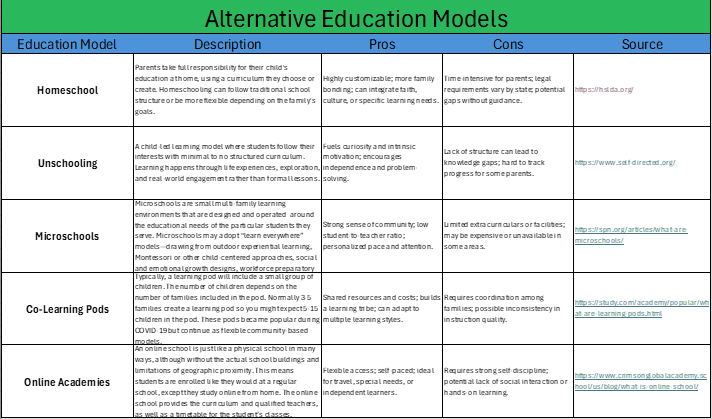
Real learning is happening in kitchens, libraries, backyards, Zoom rooms, and local communities—where elders, artisans, mentors, and curiosity lead the way. It’s not about abandoning structure, but about replacing top-down systems with frameworks that actually serve human development.
This shift is gaining urgency as artificial intelligence becomes further embedded in education. While AI may offer personalized learning opportunities, it also risks widening existing gaps in human connection and purpose-driven education. One of the few foreseeable counters to this phenomenon is the growing trend of an awakened population—those who recognize what’s not taught in schools and what should be.⁵⁵
💡 **Explore Further**: If you’re curious about alternatives, look into models like Montessori, Sudbury schools, and self-directed learning communities such as Acton Academy or Unschooling networks.
Footnotes
⁵⁵ Mintz, Steven. “The Rise of Alternative Education.” Inside Higher Ed, 11 Apr. 2023, https://www.insidehighered.com/opinion/views/2023/04/11/rise-alternative-education-opinion.
Conclusion: Reclaiming Truth Together
If you’ve made it this far, you’re already doing what most won’t—questioning the systems that shaped your thinking. That alone is revolutionary. Education was never meant to be a tool of passive compliance, but a journey of curiosity, clarity, and personal empowerment.
What we’ve unpacked here—from the manipulation of history and the suppression of practical life skills, to the invisible hands steering policy and content—isn’t just academic. It’s personal. It’s about your children. Your community. Your future.
Unlearning miseducation starts with awareness—asking why certain truths are hidden, why certain voices are excluded, and who benefits from the current system. From there, we can begin to reconstruct our understanding with purpose, clarity, and courage
But this isn’t a solo mission.
Your voice matters. What parts of this post hit home? Which ones sparked questions—or even disagreement? Drop your insights, experiences, or critiques in the comments. This post is living. It will grow, sharpen, and expand with your feedback. As we reclaim the truth in education, let’s also reclaim the power of collective dialogue.
Start there. Then explore the rest of this site. Each post connects to a larger vision of unlearning, relearning, and rising above the noise.
Work Cited
Freire, Paulo. Pedagogy of the Oppressed. Translated by Myra Bergman Ramos, Bloomsbury Publishing, 2000.
Nussbaum, Martha C. Not for Profit: Why Democracy Needs the Humanities. Princeton University Press, 2010.
“The Power of Unlearning: How to Let Go of Beliefs to Embrace Success.” Fearless Culture, https://www.fearlessculture.design/blog-posts/the-power-of-unlearning-how-to-let-go-of-beliefs-to-embrace-success
Bowen, James. A History of Western Education, Vol. III. Routledge, 2003.
Brewer, Douglas J., and Emily Teeter. Egypt and the Egyptians. Cambridge University Press, 2007.
Cicero. De Oratore, translated by E.W. Sutton.
Dewey, John. Experience and Education. Macmillan, 1938.
Kramer, Samuel Noah. History Begins at Sumer. University of Pennsylvania Press, 1981.
Kristeller, Paul Oskar. Renaissance Thought and Its Sources. Columbia University Press, 1979.
Labaree, David F. Someone Has to Fail: The Zero-Sum Game of Public Schooling. Harvard University Press, 2010.
Le Goff, Jacques. The Medieval Imagination. University of Chicago Press, 1988.
National Geographic Education Staff. “The First Public School in America.” National Geographic Education, 14 Oct. 2022, https://education.nationalgeographic.org/resource/first-public-school-america/.
Outram, Dorinda. The Enlightenment. Cambridge University Press, 2013.
Plato. The Republic, Book VII.
Carey, Kevin. “The Fundamental Way That Universities Are an Illusion.” The Chronicle of Higher Education, 2023.
https://www.chronicle.com/article/the-fundamental-way-that-universities-are-an-illusion
McClay, Wilfred M. “The Crisis in American Higher Education.” National Affairs, no. 51, Fall 2022.
https://www.nationalaffairs.com/publications/detail/the-crisis-in-american-higher-education
Vedder, Richard. Restoring the Promise: Higher Education in America. Oakland: Independent Institute, 2019.
Education Week Research Center. “Voter Turnout in School Board Elections.” EdWeek, 2016.
https://www.edweek.org/leadership/voter-turnout-in-school-board-elections.
National Center for Education Statistics. “Revenues and Expenditures for Public Elementary and Secondary Education: FY 13.” NCES, May 2015.
https://nces.ed.gov/pubs2015/2015301.pdf.
Oyez. “Brown v. Board of Education.” Oyez.org, https://www.oyez.org/cases/1940-1955/347us483
U.S. Constitution. Amendment X and XIV. National Archives.
https://www.archives.gov/founding-docs
U.S. Department of Education. “A Brief History of the U.S. Department of Education.” ed.gov.
https://www2.ed.gov/about/overview/focus/what.html
Kamenetz, Anya. “What the ‘Standardized Testing’ Debate Is Really About.” NPR, 16 Mar. 2021.
https://www.npr.org/2021/03/16/976151970/what-the-standardized-testing-debate-is-really-about.
Ravitch, Diane. The Death and Life of the Great American School System. Basic Books, 2010.
White House. “Executive Order on Combating Race and Sex Stereotyping.” Trump White House Archives, 22 Sept. 2020.
https://trumpwhitehouse.archives.gov/presidential-actions/executive-order-combating-race-sex-stereotyping/
Centers for Disease Control and Prevention. “Childhood Nutrition Facts.” CDC, 2023.
https://www.cdc.gov/healthyschools/nutrition/facts.htm
Lusardi, Annamaria. “The State of U.S. Financial Capability: The 2022 National Financial Capability Study.” FINRA Investor Education Foundation, 2023.
https://www.finrafoundation.org/financial-capability
Margolis, Eric, ed. The Hidden Curriculum in Higher Education. Routledge, 2001.
Hanson, Victor Davis. The Dying Citizen: How Progressive Elites, Tribalism, and Globalization Are Destroying the Idea of America. Basic Books, 2021.¹⁸
Grabar, Mary. Debunking Howard Zinn: Exposing the Fake History That Turned a Generation against America. Regnery History, 2019.³⁶
National Education Association. “Curriculum and Instruction.” nea.org, https://www.nea.org/professional-excellence/student-engagement/tools-tips/curriculum-and-instruction.
Pondiscio, Robert. “The End of History Class.” Thomas B. Fordham Institute, 5 Apr. 2021, https://fordhaminstitute.org/national/commentary/end-history-class.³⁸
Riley, Jason L. “The Problem With the 1619 Project.” Wall Street Journal, 18 Nov. 2019, https://www.wsj.com/articles/the-problem-with-the-1619-project-11574028583.¹⁹
Stotsky, Sandra. “History Curriculum: A Missed Opportunity for Intellectual Growth.” Pioneer Institute, 2013, https://pioneerinstitute.org/academic-standards/study-finds-history-standards-fail-to-teach-critical-thinking/.³⁷
Zinn Education Project. “About.” Zinn Education Project, https://www.zinnedproject.org/about/.¹⁷
Hess, Frederick M. “Is Zinn Education Project Replacing One Bias With Another?” Education Week, 12 Feb. 2020, https://www.edweek.org/teaching-learning/opinion-is-zinn-education-project-replacing-one-bias-with-another/2020/02.³⁵
Mintz, Steven. “The Rise of Alternative Education.” Inside Higher Ed, 11 Apr. 2023, https://www.insidehighered.com/opinion/views/2023/04/11/rise-alternative-education-opinion.